
.svg)


Ras El Rum Marsa Matrouh
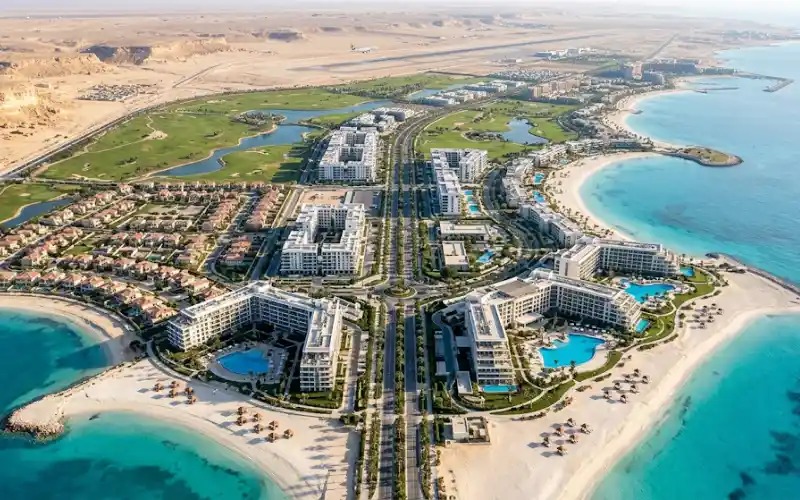
Amidst the major economic transformations taking place across Egypt’s North-West Coast, and with a new wave of Gulf-backed investments reshaping the Mediterranean coastline, the Alam Al Roum Marsa Matrouh Project emerges as one of the most important real estate and tourism developments expected in the coming years. The project is not merely another luxury coastal resort, nor is it just a seasonal destination added to Egypt’s North Coast map. It represents a much broader shift toward creating integrated urban and tourism cities that can operate throughout the year.
With announced investments estimated at around USD 29.7 billion, and a major partnership between Egypt’s New Urban Communities Authority and Qatari Diar, the Alam Al Roum Project stands as a strategic development within Egypt’s wider plan to reposition the North-West Coast as a long-term investment, tourism, and urban growth corridor. Its scale, location, and developer profile place it among the most significant projects to follow the Ras El Hekma deal, which already drew strong regional and international attention to this part of the Mediterranean.
The true value of Alam Al Roum goes beyond coastal luxury or owning a home near the sea. The project’s real importance lies in its potential to transform the area east of Marsa Matrouh into a fully integrated destination supported by hotels, residential communities, public services, entertainment, commercial zones, and year-round activities. In other words, the project’s success will not be measured only by unit sales, but by its ability to create a livable and operational city that breaks the old seasonality pattern of the North Coast.
Before diving into the language of billion-dollar figures, we must return to the origins of the place; the Alam Al Roum area carries a history and a natural character no less significant than its promising future.
Alam Al Roum Area: Where History Resides and the Future is Built
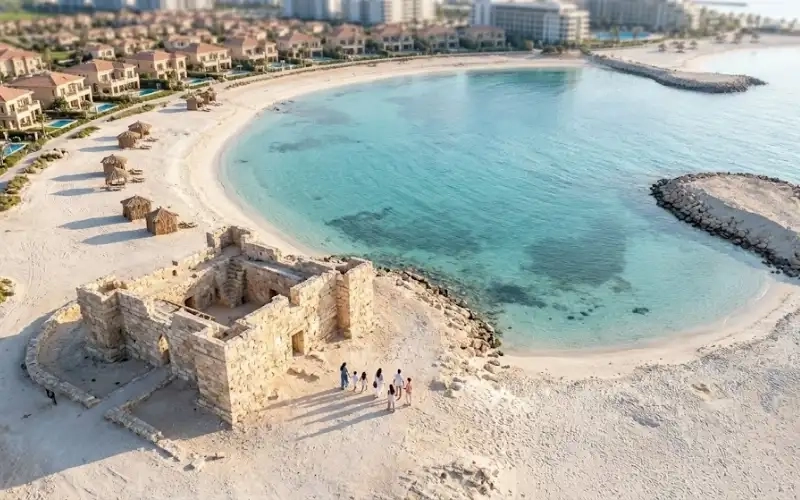
Before Alam Al Roum became an investment destination, it was known as a quiet coastal area located east of Marsa Matrouh, one of Egypt’s most naturally attractive Mediterranean cities. The area is associated with calm beaches, turquoise waters, sandy shores, and a coastal environment that has long made Marsa Matrouh a preferred destination for family tourism, relaxation, and summer stays.
What distinguishes Alam Al Roum geographically is not only its beachfront setting, but also its proximity to an existing city with urban services, an airport, road access, local communities, and basic infrastructure. This gives the project an advantage over fully isolated coastal developments that must build their entire surrounding ecosystem from scratch. A city-scale project becomes more viable when it is close to a functioning urban center such as Marsa Matrouh.
The project area also benefits from a coastal frontage of around 7.2 kilometers along the Mediterranean Sea. This extended beachfront is not simply a marketing figure; it is a major planning asset. It allows the development to diversify its products and experiences across hotels, luxury residences, villas, leisure zones, possible marina components, open spaces, and waterfront services that can support both tourism and long-term real estate value.
Today, Alam Al Roum is expected to transform from a quiet coastal zone into a large-scale integrated tourism and urban development. This transformation is the core of what makes the project different from traditional North Coast compounds. It is not intended to be only a summer resort that becomes inactive outside peak season, but a year-round destination whose success depends on operation, services, infrastructure, and professional city management.
This unique blend of a naturally attractive Mediterranean location, proximity to Marsa Matrouh, and the scale of the announced investment did not escape the vision of the developers; it was the primary catalyst for the question: What makes Alam Al Roum specifically one of the most important upcoming destinations on Egypt’s North-West Coast?
Advantages of Investing with Qatari Diar in Alam Al Roum
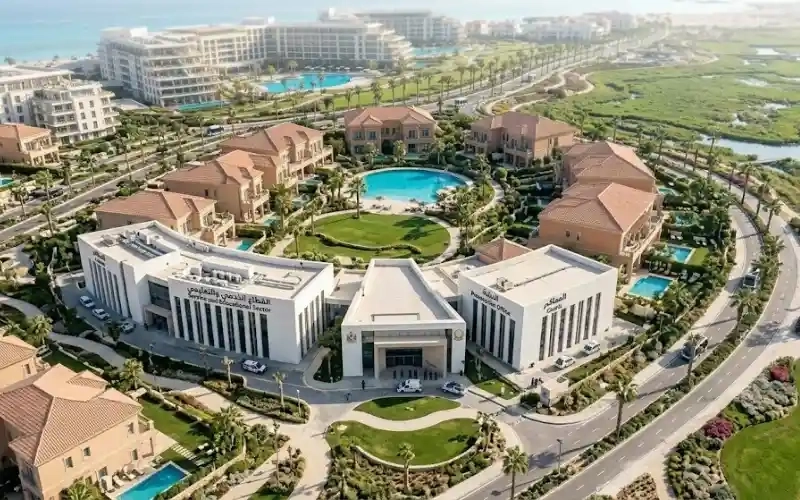
The question frequently asked among investors is: Why Alam Al Roum specifically, among all the vast areas of Egypt’s North Coast? The answer lies in the intersection of three major factors: location, land scale, and developer profile. These elements together give the project its strategic weight.
- Strategic Location Within a Growing Coastal Corridor: Alam Al Roum is located east of Marsa Matrouh, within the wider development wave extending from New Alamein to Ras El Hekma and further west toward Marsa Matrouh. This positioning places the project inside what can be described as a future tourism and investment corridor on the Mediterranean. After the Ras El Hekma deal, investors began viewing the North-West Coast not merely as a domestic summer destination, but as a region capable of attracting international tourism, long-term residence, and major Gulf capital.
- Available Land Scale: It is rare to find a coastal plot of this scale with an extended beachfront. The project covers approximately 4,900 feddans, equivalent to around 20.5 million square meters, with a direct beachfront of about 7.2 kilometers. This scale gives the developer enough room to design an integrated city rather than a large gated compound. It also allows the project to include different components such as residential neighborhoods, hotels, entertainment zones, service areas, open spaces, and possibly marina or golf-related facilities.
- Developer Strength: The presence of Qatari Diar as the main developer gives the project special weight. Qatari Diar is not a small local developer testing the market; it is a major real estate company linked to Qatari sovereign investment, with experience in large-scale and luxury developments. This gives investors a higher level of confidence, especially if the project is implemented in clear phases with official timelines, transparent documentation, and strong operational planning.
At the same time, it is important to read the opportunity objectively. A strong developer and a major investment value do not automatically guarantee returns. The real value will depend on actual execution, infrastructure quality, the approved master plan, hotel brands, pricing, payment plans, and the city’s ability to operate beyond the summer season.
Location of Alam Al Roum Marsa Matrouh and Nearby Landmarks
The project is located east of Marsa Matrouh on the Mediterranean coast. Several real estate and market sources indicate that Alam Al Roum lies approximately 12 kilometers east of Marsa Matrouh, close to the existing city and near Marsa Matrouh International Airport. This gives the project a strong accessibility advantage, especially for tourism, luxury residences, and long-term investment.
The value of the location comes not only from the beauty of the beach, but also from its position within a region expected to become a natural extension of the development wave that began with New Alamein, accelerated with Ras El Hekma, and is now moving further west toward Marsa Matrouh.
Key nearby landmarks:
- Marsa Matrouh International Airport: The project’s proximity to the airport is a major advantage for any destination targeting both domestic and international visitors. Easy air access is one of the most important factors in the success of year-round tourism cities.
- Marsa Matrouh City Center: Alam Al Roum is close to Marsa Matrouh city, which provides access to existing services, markets, healthcare facilities, roads, and urban infrastructure.
- Marsa Matrouh City: The presence of an existing city nearby supports the project’s operational potential. It can help provide labor, services, suppliers, daily needs, and local economic integration.
- Ras El Hekma Area: Ras El Hekma lies east of the wider Marsa Matrouh zone and has already become one of the most important investment stories on the North Coast. Alam Al Roum may complement Ras El Hekma rather than directly compete with it, strengthening the overall investment corridor.
- International Coastal Road: The coastal road is a key land access route connecting major North Coast destinations. Connectivity to main roads will be essential for the project’s success, especially as the area becomes more active with tourism, hospitality, and real estate development.
The geographic value of the location is further supported by the scale of the investment and the structure of the partnership, which brings us to the financial and strategic details of the project.
Investment Details and Egypt's Share of Profits
At Nile State, we believe major investment figures should be treated with accuracy and caution. The Alam Al Roum Project is based on a partnership between Egypt’s New Urban Communities Authority and Qatari Diar, with total announced investments estimated at around USD 29.7 billion.
- Total Investment: The announced investment value is around USD 29.7 billion, including approximately USD 3.5 billion related to the land payment and around USD 26.2 billion in in-kind development investment for construction and project implementation.
- Total Area: The project covers approximately 4,900 feddans, equivalent to about 20.5 million square meters, making it large enough to be planned as an integrated tourism and urban city rather than a conventional resort.
- Beachfront: Alam Al Roum enjoys a beachfront extending for around 7.2 kilometers along the Mediterranean Sea. This is one of the project’s strongest assets because it allows for product diversity, waterfront experiences, and high-end tourism components.
- Expected Annual Revenue: While some figures have circulated regarding future revenue expectations, investors should treat such numbers as projections rather than guaranteed outcomes. The project’s actual revenues will depend on execution, sales performance, hotel operations, pricing, occupancy, commercial activity, and long-term city management.
- Egypt’s Share: The deal includes a major dollar inflow related to the land payment, in addition to future economic benefits linked to development, employment, operations, tourism, and surrounding real estate activity. The project is important not only as a real estate development, but also as a foreign direct investment that supports Egypt’s broader economic and tourism strategy.
- Job Creation: Circulated and official statements have referred to the potential creation of more than 250,000 direct and indirect job opportunities. The impact is not limited to construction; it can extend to hotels, restaurants, retail, maintenance, security, transport, facility management, healthcare, entertainment, and tourism-related services.
Behind these massive figures lies an urban vision that aims to transform a large coastal land area into a complete community, not just a collection of summer homes.
Design Philosophy and Urban Master Plan
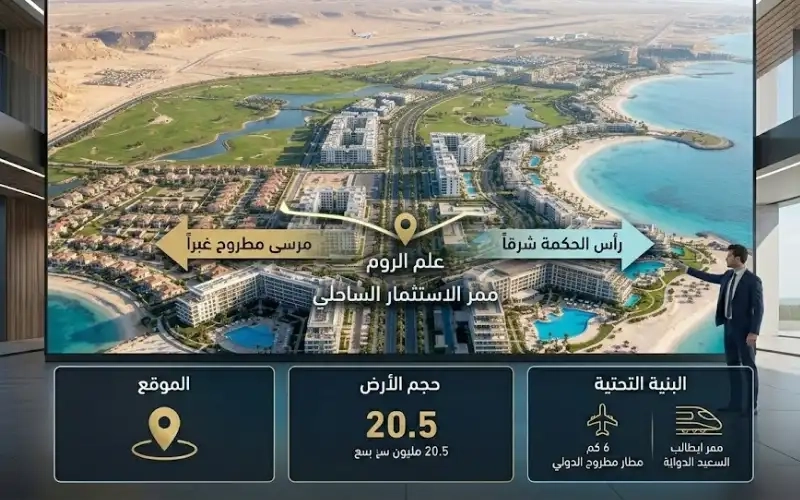
The project covers approximately 4,900 feddans, a scale that allows planners to develop a broad city-like destination with multiple functions. Such a large land area gives the developer flexibility to balance residential communities, tourism components, hotels, open spaces, public facilities, service zones, roads, and recreational areas.
The success of the master plan, however, will not depend only on luxury architecture or attractive renderings. It will depend on whether Alam Al Roum can become a functional year-round city. For decades, many North Coast developments have suffered from seasonality, with intense activity during summer and limited movement during the rest of the year. Alam Al Roum’s planning must therefore address this challenge from the beginning.
Key features of the design vision:
- Genius of Open Spaces: The large project area allows for wide roads, green areas, open spaces, walking zones, and comfortable movement across the development. This is especially important in luxury coastal projects, where privacy, low density, visual openness, and quality of life are as valuable as the beachfront itself.
- Harmony with Nature: The design vision should make use of the Mediterranean setting, the extended beachfront, and the natural coastal environment. The stronger the project’s ability to preserve the identity of the location while integrating buildings, services, and leisure zones, the greater its long-term appeal.
- Urban Sustainability: Alam Al Roum’s long-term value will depend on creating a sustainable urban environment that remains active beyond the summer months. This requires more than residential units. It requires hotels, medical services, education, retail, entertainment, professional management, and possibly extended-stay or remote-work concepts that support permanent or semi-permanent occupancy.
Unit Distribution and Services in Alam Al Roum
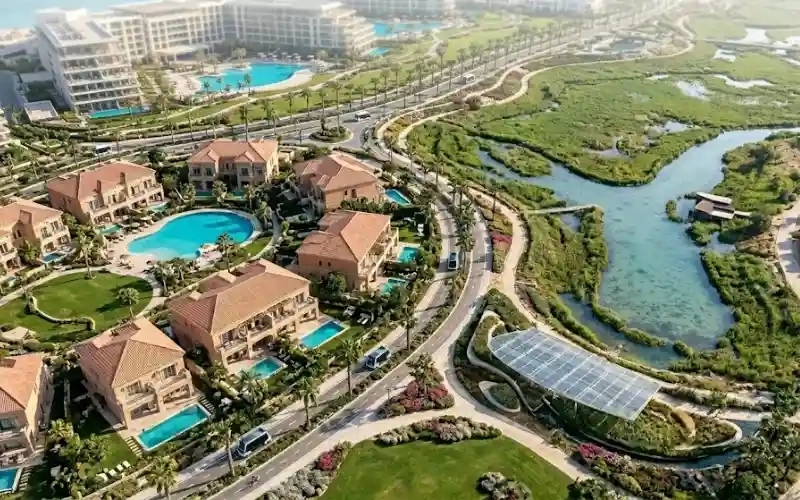
The functional master plan should make Alam Al Roum a destination for living, visiting, working, and investing simultaneously. This is what separates a true integrated city from a seasonal resort.
The project is expected to include a diverse mix of real estate and service components. The stronger the diversity of uses, the stronger the project’s ability to attract different audiences: residents, holiday homeowners, hotel guests, business operators, service providers, and long-term investors.
The Functional Structure of the City:
- Residential Sector: The residential component is expected to include different unit types such as villas, luxury apartments, coastal residences, and possibly serviced or branded residences depending on the final master plan. These units may serve different purposes, including seasonal use, long-term residence, investment, and rental income.
- Hotel and Entertainment Sector: The project is expected to include luxury hospitality components, entertainment areas, leisure facilities, and possibly marina or golf-related elements. This sector will be critical in determining whether Alam Al Roum becomes a genuine tourism destination or remains primarily a real estate sales project.
- Service and Educational Complex: For Alam Al Roum to operate year-round, it will need daily-use services such as healthcare, retail, restaurants, commercial areas, education or training facilities, administrative services, and community amenities. These are the elements that make a city livable outside the summer season.
- Public Services and City Management: Large-scale cities require strong public services, security, maintenance, facility management, transport planning, and long-term operational governance. The value of the project after delivery will depend heavily on the quality of its management, not only on the quality of its initial construction.
If implemented properly, this integrated structure could make Alam Al Roum a safer, more organized, and more sustainable coastal city that operates throughout the year.
Investment Analysis: How to Read the Opportunity?
From the perspective of the Egyptian real estate market, Alam Al Roum represents an important opportunity, but one that should be read carefully and objectively. Mega projects usually pass through three pricing and value stages: announcement, construction progress, and actual operation.
- Launch Price Advantage: Early entry in major real estate projects can sometimes offer the strongest capital appreciation. However, this advantage depends on the relationship between price, location, developer credibility, payment plan, delivery timeline, and execution risk. A low launch price is only valuable if the project delivers real progress.
- Guided Geographical Growth: The area extending from New Alamein to Ras El Hekma and Marsa Matrouh is being repositioned as a major coastal investment corridor. Buying in Alam Al Roum means entering a region that is being reshaped by infrastructure, tourism, and sovereign-backed development.
- Sustainable Rental Yield: If Alam Al Roum succeeds in becoming a year-round city with hotels, services, events, and commercial activity, rental demand may become less dependent on the short summer season. But if the project remains seasonal, rental income will likely remain concentrated in a few peak months.
The opportunity is significant, but timing, product selection, official documents, and execution progress will determine whether the investment becomes a long-term success.
Execution Timeline and Delivery Dates (Phase 1)
Because Alam Al Roum is a mega project, it should be expected to develop in phases rather than all at once. Projects of this scale require master planning, infrastructure works, product phasing, utility delivery, hospitality partnerships, and long-term operational preparation.
- Phase One — 2026: The first phase is expected to represent the transition from announcement to practical implementation. However, investors should monitor official statements from the Egyptian government and Qatari Diar regarding the exact scope of this phase, the areas included, product types, construction timelines, and booking details. In mega projects, the start of construction, approval of the master plan, and visibility of infrastructure works are more important than promotional expectations.
- Phase Two — 2031 and beyond: Later phases are expected to develop gradually according to the approved master plan and market conditions. Since Alam Al Roum is planned as an integrated city, completion may extend over many years, with different areas delivered at different times depending on construction priorities, sales plans, hotel development, and infrastructure progress.
Delivery dates for units should therefore be assessed based on official contracts, reservation documents, development permits, phase plans, and infrastructure progress. Investors should not rely only on marketing announcements; they should request clear documentation before making a purchase decision.
Price Expectations and Booking Process
We maintain full transparency: Qatari Diar has not yet released detailed official price lists for the residential units. This is understandable at this stage, as the project still requires detailed planning, unit distribution, product definition, service planning, and official phasing before final pricing can be announced.
Logically, prices will be influenced by several factors: proximity to the sea, view quality, unit type, service level, finishing specifications, payment terms, delivery date, hotel and service components, and the level of demand generated by the project’s launch.
It is also important to distinguish between market speculation and official pricing. Any prices circulating before the official launch should be treated as estimates or expectations, not confirmed figures. Serious buyers should wait for official price lists, approved layouts, reservation contracts, and clear payment plans.
For the latest updates on Alam Al Roum prices, payment systems, available unit types, and booking procedures, contact the Nile State team specialized in North Coast projects.
Why Investors Prioritize Alam Al Roum?
Beyond price and location, the project’s weight rests on three major pillars: investment scale, developer profile, and its position within the new North-West Coast growth story.
The partnership between Egypt’s New Urban Communities Authority and Qatari Diar gives the project a higher level of seriousness than many conventional coastal developments. It also places Alam Al Roum within the wider context of Gulf-backed investment in Egypt’s Mediterranean coastline.
Investors prioritize Alam Al Roum because it may offer early exposure to a project located near Marsa Matrouh, within a region that is expected to witness increased demand as infrastructure improves, hotels enter the market, and surrounding areas are repriced.
However, prioritizing Alam Al Roum does not mean buying without analysis. Investors should compare it with Ras El Hekma, New Alamein, Marsa Matrouh, and other North Coast destinations. They should also evaluate pricing, delivery timelines, hotel brands, infrastructure, city management, and legal clarity before making a final decision.
Comparison: Alam Al Roum vs. Ras El Hekma
- Similarities: Both projects are located on Egypt’s North-West Coast. Both reflect the state’s broader direction toward transforming the area from a seasonal summer market into a major tourism and investment region. Both are connected to large Gulf-backed investments and aim to develop integrated destinations rather than simple beachfront resorts.
- Differences: Ras El Hekma gained earlier and wider momentum after the major Emirati-backed deal that placed the area strongly on the global investment map. Alam Al Roum, by contrast, adds Qatari weight to the same coastal corridor and offers a different type of opportunity because it is closer to Marsa Matrouh and still in an earlier phase of development.
From an investor’s perspective, Ras El Hekma may represent a more widely recognized and more mature investment story, while Alam Al Roum may offer earlier exposure to a project whose full pricing, phasing, and master plan have not yet been fully reflected in the market.
The conclusion is simple: Ras El Hekma and Alam Al Roum should not be viewed only as competitors. They may be complementary parts of a larger coastal transformation. Ras El Hekma helped put the region on the map, while Alam Al Roum may strengthen the westward expansion toward Marsa Matrouh.
About Qatari Diar (The Developer)
Qatari Diar is a major real estate developer linked to Qatari sovereign investment and known for involvement in large-scale and high-end projects. Its presence as the main developer gives Alam Al Roum strategic weight and increases market confidence in the seriousness of the development.
The importance of Qatari Diar lies not only in its financial strength, but also in the long-term nature of the investment. A project of this size is not a quick sales campaign; it is a multi-year development that requires planning, infrastructure, hospitality partnerships, city management, and continued operational oversight.
For Egypt, Qatari Diar’s entry into Alam Al Roum strengthens the idea that the North-West Coast is becoming an international investment destination. After the strong Emirati presence in Ras El Hekma, the Qatari presence in Alam Al Roum reinforces the idea that the region is attracting major Gulf capital and may become one of the most important Mediterranean development corridors in the coming decade.
Do not wait until the city is complete and prices reflect every stage of growth. Be among the first to receive the project brochure, official master plan, and detailed floor plans once released. The Nile State team is ready to help you evaluate the most suitable investment opportunity based on your budget, goals, and risk profile.
FAQ
What is the Alam Al Roum project?
Alam Al Roum is a major urban, tourism, and investment project located east of Marsa Matrouh on Egypt’s North-West Coast. It is being developed through a partnership between the New Urban Communities Authority and Qatari Diar, with announced investments estimated at around USD 29.7 billion.
Who is the developer?
The main developer is Qatari Diar, in partnership with Egypt’s New Urban Communities Authority. Qatari Diar is a major real estate developer linked to Qatari sovereign investment and has experience in large-scale luxury developments.
When does construction begin?
The project is expected to move forward in phases, with early implementation activity linked to the first development stage. Investors should follow official statements from the Egyptian government and Qatari Diar to confirm the exact construction schedule, phase scope, and delivery timelines.
What is Egypt's share?
The deal includes a major land-related payment estimated at around USD 3.5 billion, in addition to large-scale in-kind development investment estimated at around USD 26.2 billion. Egypt is also expected to benefit economically through investment inflows, job creation, tourism activity, infrastructure development, and surrounding real estate growth.
How many jobs will it provide?
Circulated and official statements have referred to the project’s potential to create more than 250,000 direct and indirect job opportunities. These jobs may include construction, hospitality, retail, maintenance, security, transport, facility management, healthcare, entertainment, and other tourism-related services.
0 Comments
Recent Blogs
A Project Sheikh Zayed
Read more

Free Zones in Egypt
Read more

Usufruct Rights in Commercial and Industrial Land in Egypt
Read more

Types of Free Zones and Industrial Zones in Egypt
Read more

Egypt’s New Investment Laws 2026
Read more

Free zones in Egypt and the world
Read more
Popular Tags
- Alam Al Roum Area: Where History Resides and the Future is Built
- Advantages of Investing with Qatari Diar in Alam Al Roum
- Location of Alam Al Roum Marsa Matrouh and Nearby Landmarks
- Investment Details and Egypt's Share of Profits
- Design Philosophy and Urban Master Plan
- Unit Distribution and Services in Alam Al Roum
- Investment Analysis: How to Read the Opportunity?
- Execution Timeline and Delivery Dates (Phase 1)
- Price Expectations and Booking Process
- Why Investors Prioritize Alam Al Roum?
- Comparison: Alam Al Roum vs. Ras El Hekma
- About Qatari Diar (The Developer)
- FAQ
- What is the Alam Al Roum project?
- Who is the developer?
- When does construction begin?
- What is Egypt's share?
- How many jobs will it provide?
Leave Comment